Clever AI Detector Review: Features, Accuracy, and Results
Clever AI Detector gives unusually detailed results for a free checker. Its 10,000-word limit, sentence signals, plus candid probability framing make it useful, though no score can prove authorship.
Clever AI Detector is one of the most capable free checkers we reviewed. It handles up to 10,000 words per scan, highlights sentence-level signals, requires no account, plus reports probability rather than pretending its result is proof. Its published August 2026 benchmark is impressive, though the company ran that test itself, so serious decisions still need human review.
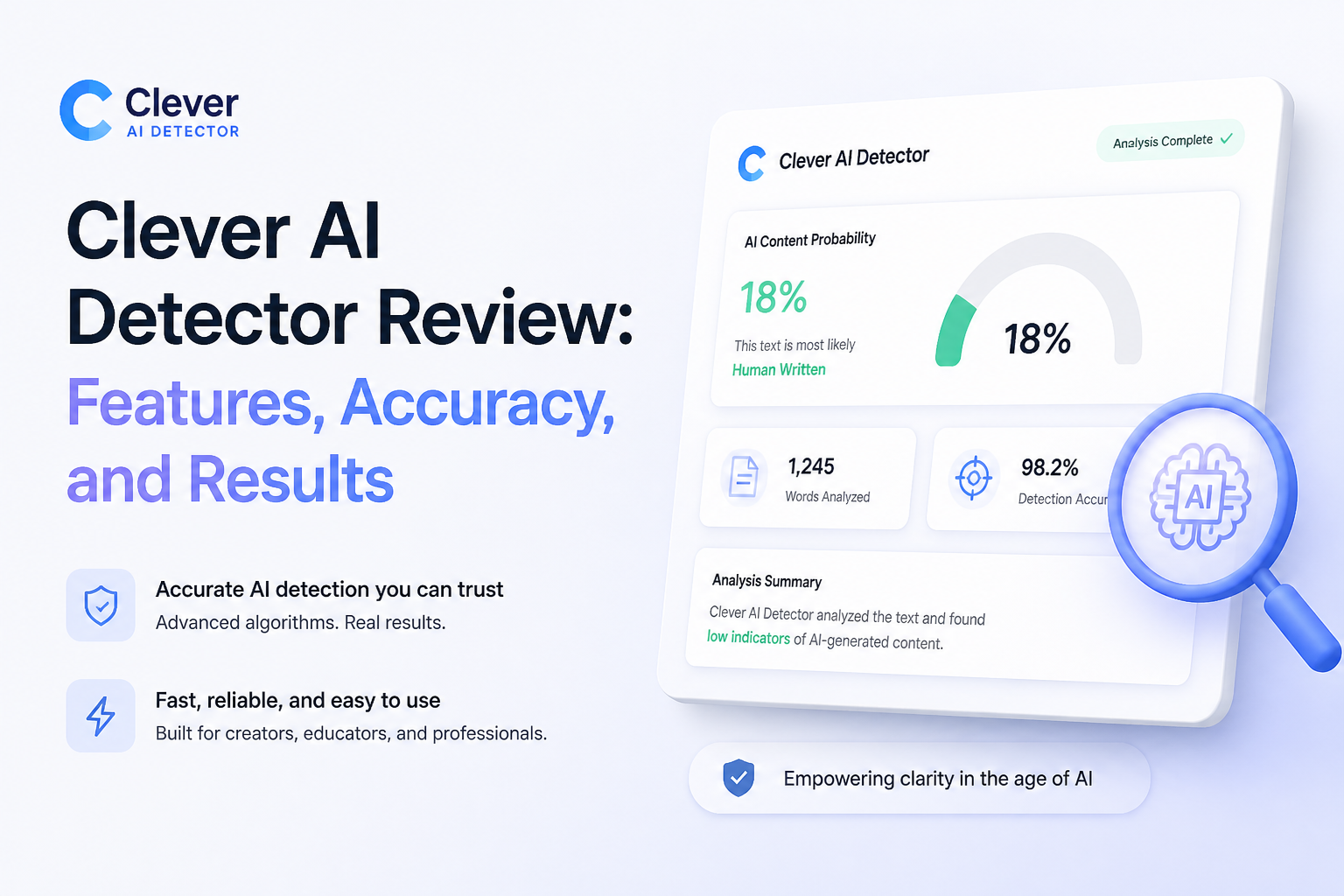
Clever AI Detector at a Glance
9.1/10Clever AI Detector is a browser-based checker that estimates how closely English text resembles AI-generated writing. It provides an overall probability plus sentence-level signals.
Best forEditors, writers, teachers, plus content teams seeking a free screening signal before manual review
- AI probability score with confidence context
- Sentence-by-sentence signal highlighting
- Checks from 80 to 10,000 words
- Optional account with scan history
- Unlimited browser-based checks
- Generous free allowance
- Strong published benchmark results
- Clear probability-based reporting
- English only
- Vendor-run benchmark
- Cannot prove who wrote a document
Clever AI Detector Features, Accuracy, Limits, Plus Test Results
01 Detection Performance
Strong published results with meaningful caveats
9.4/10
Detection Performance
Strong published results with meaningful caveats
Clever AI Detector’s strongest evidence comes from an August 2026 benchmark using 750 essays from the public GEDE research corpus. The company reports that its detector flagged 96.7% of 600 AI-involved texts, including generated, rewritten, AI-edited, plus deliberately humanized samples.
The harder categories matter more than raw chatbot output. Clever reported 92% detection on humanized text, 94.7% on AI-improved drafts, plus 100% on direct AI output. None of the 150 human control essays were flagged. Those are excellent results, but this was still a vendor-run benchmark covering English academic essays, not an independent audit across every writing genre.
- 96.7% reported detection across 600 AI-involved essays
- 92% reported result on deliberately humanized samples
- No flags among 150 human control essays in the published run
- Public GEDE corpus makes the methodology easier to inspect
- Benchmark was conducted by the product’s own company
- Test corpus focused mainly on English academic essays
- Accuracy on fiction, technical prose, or brief messages remains less certain
02 Result Explanations
More useful than a bare percentage
9.2/10
Result Explanations
More useful than a bare percentage
The tool returns an overall AI probability, a confidence indicator, plus sentence-level signals. That last part is genuinely useful. Instead of staring at one alarming number, a writer can see which passages contain unusually predictable phrasing or uniform sentence patterns.
Clever also explains that a 90% AI score does not mean 90% of the words came from a machine. It means the text’s statistical profile resembles model-generated writing. This distinction is easy to miss, yet it changes how the result should be interpreted.
- Highlights individual sentences that influenced the result
- Explains scores as probability rather than authorship proof
- Confidence framing exposes uncertain cases
- Report can be copied for later review
- Sentence signals do not explain every underlying feature
- Users may still overreact to a high percentage
03 Ease of Use
A direct paste, check, review workflow
9.1/10
Ease of Use
A direct paste, check, review workflow
The workflow has almost no learning curve. Paste between 80 plus 10,000 words, press the check button, then review the probability score beside the highlighted sentences. No account is required for an ordinary scan.
The 80-word minimum is reasonable because tiny samples offer too little statistical information. Still, it prevents quick checks of a short email, headline, social caption, or isolated paragraph.
- No account required for standard checks
- Clean single-page workflow
- Results organize the overall score plus local signals clearly
- Optional account preserves previous scans
- Cannot assess samples below 80 words
- English is the only clearly supported language
- No browser extension or document-editor plug-in is listed
04 Limits Plus Access
A rare free tier without a token-sized allowance
9.6/10
Limits Plus Access
A rare free tier without a token-sized allowance
The pricing is refreshingly simple: $0, up to 10,000 words per check, with unlimited runs subject to service availability. The full score, confidence result, plus sentence signals are not locked behind a subscription.
An optional free account adds check history. People who only need an occasional second opinion can use the detector without creating one. There are no advertised paid detector plans as of September 5, 2026.
- Completely free at the time of review
- Up to 10,000 words in one check
- No stated cap on the number of scans
- No signup wall for core detection features
- No ads or paid report unlock
- Free access could change if paid features arrive later
- Unlimited use remains subject to service availability
05 Privacy Plus Responsible Use
Good warnings, though sensitive text still needs care
8.3/10
Privacy Plus Responsible Use
Good warnings, though sensitive text still needs care
Clever states that submitted text is not used to train the detector. Signed-in users can keep a history of previous checks, while account creation remains optional. Anyone scanning confidential client work, unpublished research, legal material, or private student records should still read the privacy terms before pasting.
The product repeatedly warns that an AI score is a signal rather than evidence. That is the right stance. Detection results should be combined with drafts, version history, source notes, plus a conversation with the writer.
- States that submitted text is not used for model training
- Account creation is optional
- Responsible-use language appears prominently
- Warns against treating a result as sole proof
- Cloud processing is unsuitable for some confidential documents
- Saved history creates an extra privacy choice for signed-in users
- Public documentation gives fewer technical details than an external security audit
How We Evaluated Clever AI Detector’s Features Plus Accuracy Claims
We reviewed the live product page, its input requirements, report structure, pricing, account options, privacy statements, plus responsible-use guidance on September 5, 2026. Accuracy scoring relied on the published August 2026 GEDE benchmark, which used 600 AI-involved essays plus 150 pre-ChatGPT human essays across eight detectors.
We gave more weight to performance on rewritten, AI-edited, plus humanized passages than to untouched chatbot output. We also reduced the score slightly because CleverFiles ran the benchmark itself, even though the underlying dataset is public plus the page describes its methodology in useful detail.
When Clever AI Detector Should Not Decide the Outcome
Do not use Clever AI Detector as the only evidence in an academic misconduct case, employee review, publishing dispute, or payment decision. A high probability describes patterns in the text. It does not identify the person or software that created it.
Extra caution is needed with short samples, formal writing, heavily edited prose, plus work from non-native English writers. Use the score to decide what needs a closer look, then examine document history, earlier drafts, citations, plus the writer’s explanation of their process.
Clever AI Detector: How It Scored Across Our Review Criteria
| Category | Performance | Score |
|---|---|---|
| 01 Detection Performance | 9.4/10 | |
| 02 Result Explanations | 9.2/10 | |
| 03 Ease of Use | 9.1/10 | |
| 04 Limits Plus Access | 9.6/10 | |
| 05 Privacy Plus Responsible Use | 8.3/10 |
What Writers Say About AI Detector Results
A Reddit user tested older personal writing plus reported that most samples were flagged around 70% to 85% AI by detector tools. Their experience shows why human-written controls matter.
One commenter found that polished academic phrasing was more likely to trigger AI flags, even when the writing was original. This is a recurring concern with formal prose.
A user comparing detector results concluded that pure AI drafts were easier to identify, while lightly edited or hybrid writing produced inconsistent outcomes.
Should You Use Clever AI Detector?
Clever AI Detector is easy to recommend as a free first-pass checker. The 10,000-word allowance, sentence signals, plus honest treatment of uncertainty give writers more context than a simple red or green label.
Editors, content managers, plus educators can use it to spot passages worth reviewing. Anyone making disciplinary, hiring, grading, or contractual decisions should skip the idea of a one-click verdict, then collect draft history plus other evidence instead.
Check a full section of at least 250 words, inspect the highlighted sentences, then compare the result with drafts or revision history before drawing any conclusion.