Fujifilm Recover Deleted Photos: 2026 Guide
Deleted a Fujifilm frame or formatted the wrong card? Stop using the media, then work through these five recovery routes without writing new data over the photos.
Turn off the camera plus remove the card immediately. Connect it through a card reader, scan it with Disk Drill, preview the missing RAF or JPEG files, then recover them to a different drive.
Do not take another picture, format the card, run an in-camera repair, or save recovered files back to it. Fujifilm's manuals warn that deleted frames are not recoverable through the camera itself. New writes may overwrite data that recovery software could otherwise find. (app.fujifilm-dsc.com)
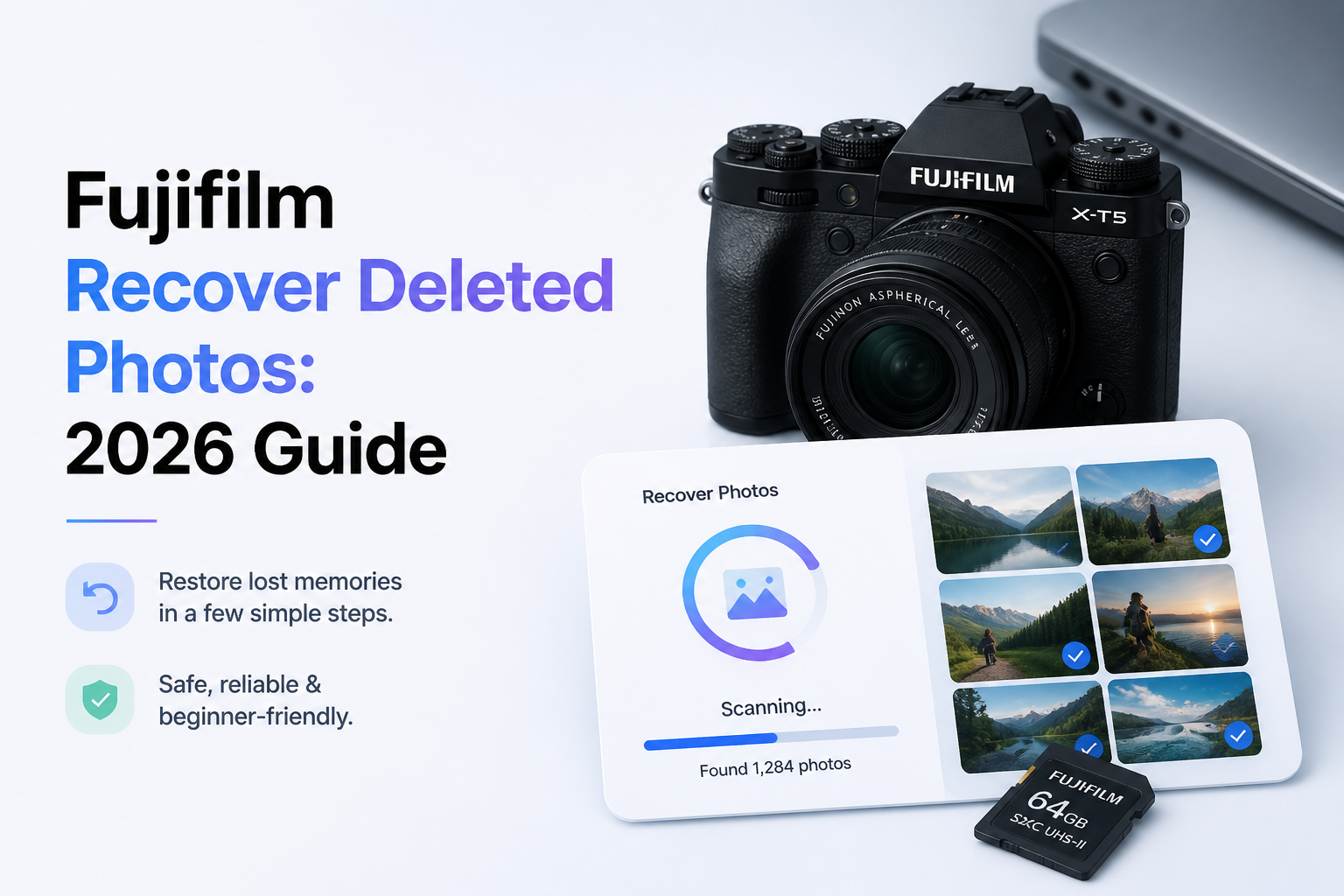
Recover Deleted Fujifilm Photos → Disk Drill
Scans Fujifilm camera cards for RAF, JPEG, DNG, MOV, plus MP4 files · Supports Windows plus macOS · Can preview found photos before recovery
What Happens After a Fujifilm Photo Is Deleted?
The camera removes the file's directory reference, but the photo data may remain in the card's unused space until another shot, format operation, or file write replaces it. This is why a card pulled out after one accidental deletion has a better practical chance than a card used for the rest of the day.
Fujifilm cameras do not provide a normal undo bin for erased frames. Recovery therefore happens from a backup or by reading the card outside the camera.
When Not to Scan a Fujifilm Memory Card at Home
Do not keep scanning a card that vanishes midway, reports changing capacity, becomes unusually warm, or has cracked contacts. Create one sector-level image only if the card reads steadily. Otherwise, power it down plus speak with a flash-recovery lab.
Choose a Fujifilm Photo Recovery Method
Start with the least invasive option that matches where the files were lost.
| Method | Best for | Time | Success rate |
|---|---|---|---|
| 1. Recover Fujifilm Photos With Disk Drill TRY FIRST | Deleted or formatted camera cards | ~15–60 min | ● 85% |
| 2. Restore Fujifilm Photos From a Backup | Previously imported photos | ~5–30 min | ● 100% |
| 3. Check the Recycle Bin or Trash | Computer-side deletion | ~2 min | ● 95% |
| 4. Scan the Fujifilm Card With PhotoRec | Free deep file carving | ~30–120 min | ● 68% |
| 5. Send the Card to a Recovery Lab | Physical or electrical damage | ~3–14 days | ● 55% |
Top 5 Ways to Recover Deleted Fujifilm Photos
01 Recover Fujifilm Photos With Disk Drill
Best first scan for deleted, formatted, or inaccessible camera cards
~15–60 min
Recover Fujifilm Photos With Disk Drill
Best first scan for deleted, formatted, or inaccessible camera cards
Disk Drill is the simplest first choice when RAF or JPEG files vanished from a Fujifilm SD, CFexpress, or other camera card. Its Advanced Camera Recovery mode recognizes Fujifilm recording structures, while the regular scan can locate deleted photos through file-system records or file signatures. (cleverfiles.com)
- Turn off the Fujifilm camera, remove the memory card, then slide its physical lock switch to Lock if it has one.
- Install Disk Drill from the official website on your computer's internal drive, not on the affected card.
- Insert the card through a reliable reader. If the card disconnects, runs slowly, or reports errors, create a byte-to-byte backup in Disk Drill first, then scan that image.
- Select the card, choose Advanced Camera Recovery for camera media, then start the search. Try the universal scan afterward if expected photos remain missing.
- Open Pictures, filter for
.RAF,.JPG, or.DNG, then preview several files at full size. - Select the usable photos, click Recover, then save them to a different drive or folder. Never recover onto the source card.

02 Restore Fujifilm Photos From a Backup
Safest option when the pictures were imported before deletion
~5–30 min
Restore Fujifilm Photos From a Backup
Safest option when the pictures were imported before deletion
Before scanning the card, check every place used during import. Lightroom catalogs, Photos libraries, cloud folders, NAS snapshots, plus automatic phone transfers may contain another copy even when the original folder looks empty.
- Search the computer for
*.RAFplus*.JPG, then sort the results by the shoot date. - Open Lightroom, Capture One, Photos, or the importer you normally use. Check rejected images, hidden folders, missing-file views, plus recently deleted areas.
- Review OneDrive, iCloud Photos, Google Photos, Dropbox, your NAS, or any external backup drive used around the shoot date.
- If you use Windows File History, Time Machine, or NAS snapshots, open the folder that held the import, then choose a version created before deletion.
- Restore the files to a new folder, open several RAF plus JPEG images, then copy the verified set to a second location.
03 Check the Recycle Bin or Trash
Fastest fix when photos disappeared after reaching the computer
~2 min
Check the Recycle Bin or Trash
Fastest fix when photos disappeared after reaching the computer
This method applies only if the Fujifilm pictures were deleted from a computer or attached drive. Deleting a frame inside the camera does not send it to the computer's Recycle Bin or Trash.
- On Windows, open Recycle Bin. On macOS, open Trash from the Dock.
- Sort by deletion date, original location, file type, or size to narrow a large list.
- Search for
DSCF,.RAF,.JPG, or a custom filename used during import. - Select the missing photos, then choose Restore on Windows or Put Back on macOS.
- Open the restored files at full resolution, then back them up before clearing the bin.
04 Scan the Fujifilm Card With PhotoRec
Free fallback for comfortable, patient computer users
~30–120 min
Scan the Fujifilm Card With PhotoRec
Free fallback for comfortable, patient computer users
PhotoRec is a free, open-source file carver that reads underlying data even when a card's file system is damaged or reformatted. The tradeoff is messy output, since original filenames plus folder structure are generally not restored. (cgsecurity.org)
- Download TestDisk plus PhotoRec from the CGSecurity website, then extract the package to the computer.
- Connect the Fujifilm card through a reader, then launch QPhotoRec for the graphical interface or PhotoRec for the terminal interface.
- Select the physical memory card carefully. Confirm its capacity so you do not scan the wrong disk.
- Open File Formats, reduce the selection to the formats you need, such as RAF, JPEG, DNG, MOV, or MP4.
- Choose the relevant partition. For a formatted or badly damaged card, scan the whole partition rather than free space only.
- Set the destination to another drive, start recovery, then sort the generated folders by file type, dimensions, date metadata, or visual content.
05 Send the Card to a Recovery Lab
Right move for cracked, burned, unstable, or completely undetected media
~3–14 days
Send the Card to a Recovery Lab
Right move for cracked, burned, unstable, or completely undetected media
Software cannot scan media that no computer can read reliably. A specialist may work with damaged controllers, broken connectors, failing flash memory, or cards that heat up plus disconnect during access.
- Stop powering the card if it becomes hot, disconnects repeatedly, has visible damage, or is missing from both Disk Management plus Disk Utility.
- Place the card in an antistatic sleeve or small protective case. Do not bend it, clean contacts with liquids, freeze it, or open its shell.
- Contact a lab that handles flash-memory recovery. Describe the Fujifilm model, card type, deletion or damage event, plus any software already tried.
- Ask whether diagnosis is free, whether payment depends on recovery, how privacy is handled, plus whether original media will be returned.
- Review the lab's recoverable-file list or sample images before approving final delivery where that option is offered.
Which Fujifilm Recovery Method Should You Use?
Start with Disk Drill if the photos were deleted in-camera, lost after formatting, or trapped on a card that appears RAW. Check backups plus the computer's deleted-items folder first only when the files had already been imported.
PhotoRec is the sensible free fallback when filenames do not matter. Skip software entirely if the card is physically damaged, unstable, or invisible to the operating system.
Keep the original card untouched until every recovered RAF or JPEG opens correctly from two separate storage locations.