How Many Times Should You Humanize Text?
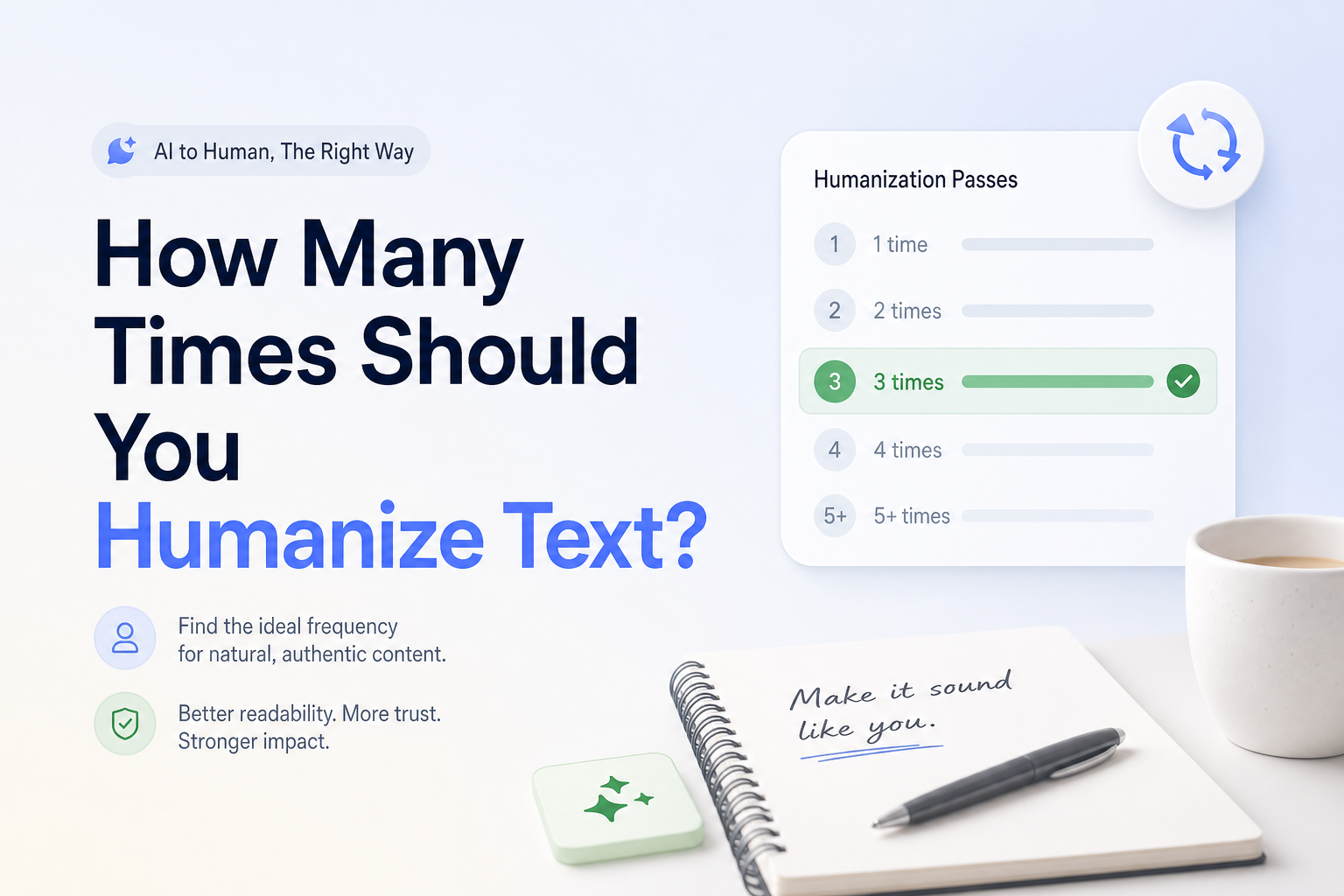
Most text needs one humanization pass, not a chain of rewrites. A second selective pass can help stubborn sections, while a third usually causes more trouble than it fixes.
Humanize text once in most cases. Use a second pass only on sections that still sound mechanical. After two passes, switch to manual editing or rebuild the draft from its main points.
Repeated humanization can change facts, quotations, technical terms, citations, or the writer’s intended point. Compare every processed version with the source before using it.
Run One Controlled Humanization Pass → Clever AI Humanizer
Three writing styles help match blogs, academic work, or formal copy · Browser-based processing · Review the result before publishing
Top 5 Ways to Decide How Many Times to Humanize Text
01 Run One Controlled Pass With Clever AI Humanizer
Best for a solid draft that sounds stiff, repetitive, or overly polished
~3 min
Run One Controlled Pass With Clever AI Humanizer
Best for a solid draft that sounds stiff, repetitive, or overly polished
For most drafts, one humanization pass is enough. Clever AI Humanizer lets you choose Casual, Simple Academic, or Simple Formal, so the first pass can match the intended reader instead of relying on several random rewrites.
- Finish the draft before humanizing it. Fix missing facts, weak logic, or incomplete sections first.
- Open Clever AI Humanizer, then paste a complete section into the input box.
- Choose Casual, Simple Academic, or Simple Formal based on where the text will appear.
- Run the humanizer once, then compare the result with your original paragraph by paragraph.
- Restore any technical term, quotation, statistic, product name, or phrase whose meaning shifted.
- Read the result aloud once before publishing it.

02 Humanize Only the Weak Sections a Second Time
Useful when a few paragraphs still feel mechanical after the first pass
~5 min
Humanize Only the Weak Sections a Second Time
Useful when a few paragraphs still feel mechanical after the first pass
A second pass can help, but it should be selective. Reprocessing the whole document often changes sentences that were already clear while raising the chance of factual drift.
- Mark only passages with repeated sentence openings, canned transitions, or noticeably flat rhythm.
- Confirm that each marked passage contains enough context to stand on its own.
- Submit one marked section at a time rather than the full document.
- Compare the new version with both the source draft plus the first-pass result.
- Keep the version that sounds natural without losing detail.
- Stop after this second pass. Move to manual editing if the section still feels wrong.
03 Replace a Third Pass With a Manual Line Edit
Safer for text where wording, voice, or factual precision matters
~10 min
Replace a Third Pass With a Manual Line Edit
Safer for text where wording, voice, or factual precision matters
If two passes have not fixed the problem, another automated rewrite is rarely the cleanest answer. A short manual edit gives you direct control over voice, emphasis, pacing, plus meaning.
- Read the text aloud, marking any sentence that feels difficult to say naturally.
- Replace vague openings such as
It is worth notingwith the actual point. - Split long sentences that carry more than one main thought.
- Vary sentence length without forcing slang, fragments, or deliberate mistakes.
- Add specific details the original draft omitted, such as a concrete example or limitation.
- Remove repeated conclusions, summary lines, plus transitions that explain obvious connections.
04 Rebuild the Draft From Its Main Points
The better choice when repeated humanization has made the writing vague
~20 min
Rebuild the Draft From Its Main Points
The better choice when repeated humanization has made the writing vague
Repeated processing can produce text that is technically different yet less useful. If the piece has lost its argument, examples, or recognizable voice, return to the source material instead of polishing the weakened version again.
- Set the processed draft aside so its wording does not steer the rebuild.
- List the key claim, supporting facts, necessary examples, plus intended takeaway.
- Check every factual point against the original source or your own notes.
- Write each section from those points using direct language.
- Use a humanizer once only if the rebuilt copy still has obvious machine-like patterns.
- Complete a final accuracy check against the source material.
05 Skip Humanization When the Draft Already Works
Right for clear writing that sounds appropriate for its actual setting
~2 min
Skip Humanization When the Draft Already Works
Right for clear writing that sounds appropriate for its actual setting
Not every AI-assisted draft needs humanization. Instructions, reference copy, short emails, or plain technical notes may benefit more from accuracy than stylistic variation.
- Read the draft without checking a detector first.
- Confirm that the tone fits the reader plus the purpose.
- Look for repetition, unsupported statements, vague wording, or unnatural transitions.
- Ask whether a rewrite would solve a real problem rather than alter the text for its own sake.
- Make small manual corrections where needed.
- Publish or submit only after checking any relevant disclosure, workplace, school, or platform rules.
When Another Humanization Pass Makes the Draft Worse
Stop when the output starts replacing precise terms with broad synonyms, removing useful detail, or making every sentence sound equally casual. Those are signs that the tool is rewriting language without improving the underlying thought.
Legal wording, medical information, quotations, research summaries, plus technical instructions deserve extra care. For those materials, use the lightest possible rewrite followed by a source check.
How the One-Pass Rule Changes by Type of Writing
A casual blog introduction may tolerate one broad pass plus a few manual tweaks. A client email often needs only two or three line edits. A research summary may need no humanizer at all if the wording is already clear, since preserving precise meaning matters more than changing its rhythm.
Choose How Many Times to Humanize Your Text
Start with the lightest method that fixes a real writing problem.
| Method | Best for | Time | Success rate |
|---|---|---|---|
| 1. Run One Controlled Pass With Clever AI Humanizer TRY FIRST | Most complete drafts | ~3 min | ● 92% |
| 2. Humanize Only the Weak Sections a Second Time | A few stubborn paragraphs | ~5 min | ● 78% |
| 3. Replace a Third Pass With a Manual Line Edit | Voice plus precision | ~10 min | ● 88% |
| 4. Rebuild the Draft From Its Main Points | Vague, damaged copy | ~20 min | ● 84% |
| 5. Skip Humanization When the Draft Already Works | Clear finished writing | ~2 min | ● 95% |
How Many Humanization Passes Should You Use?
One pass with Clever AI Humanizer is the sensible first move when your draft has the right facts but sounds stiff or repetitive. Try a second pass only on isolated weak sections.
If the text still feels wrong after that, stop processing it. Edit the lines yourself or rebuild the draft from its main points, since a third full pass is more likely to blur the meaning than rescue the prose.
Save the original draft, run one controlled pass, then compare both versions line by line before deciding whether any section deserves a second try.