R-Studio for Digital Camera Photo Recovery: Review 2026
R-Studio has serious recovery tools, but recovering photos from an SD or CF card feels more technical than it needs to. For most photographers, Disk Drill offers a clearer route from damaged card to previewed files.
R-Studio can find photos on deleted, formatted, or damaged camera cards, but its crowded device tree, scan settings, plus 1,024 KB demo limit make it a poor first choice for a stressed photographer. Download Disk Drill instead for a cleaner preview workflow plus a dedicated Advanced Camera Recovery mode.
R-Studio exposes enough low-level controls that an inexperienced user can scan the wrong object, misread duplicate results, or recover files to an unsafe destination.
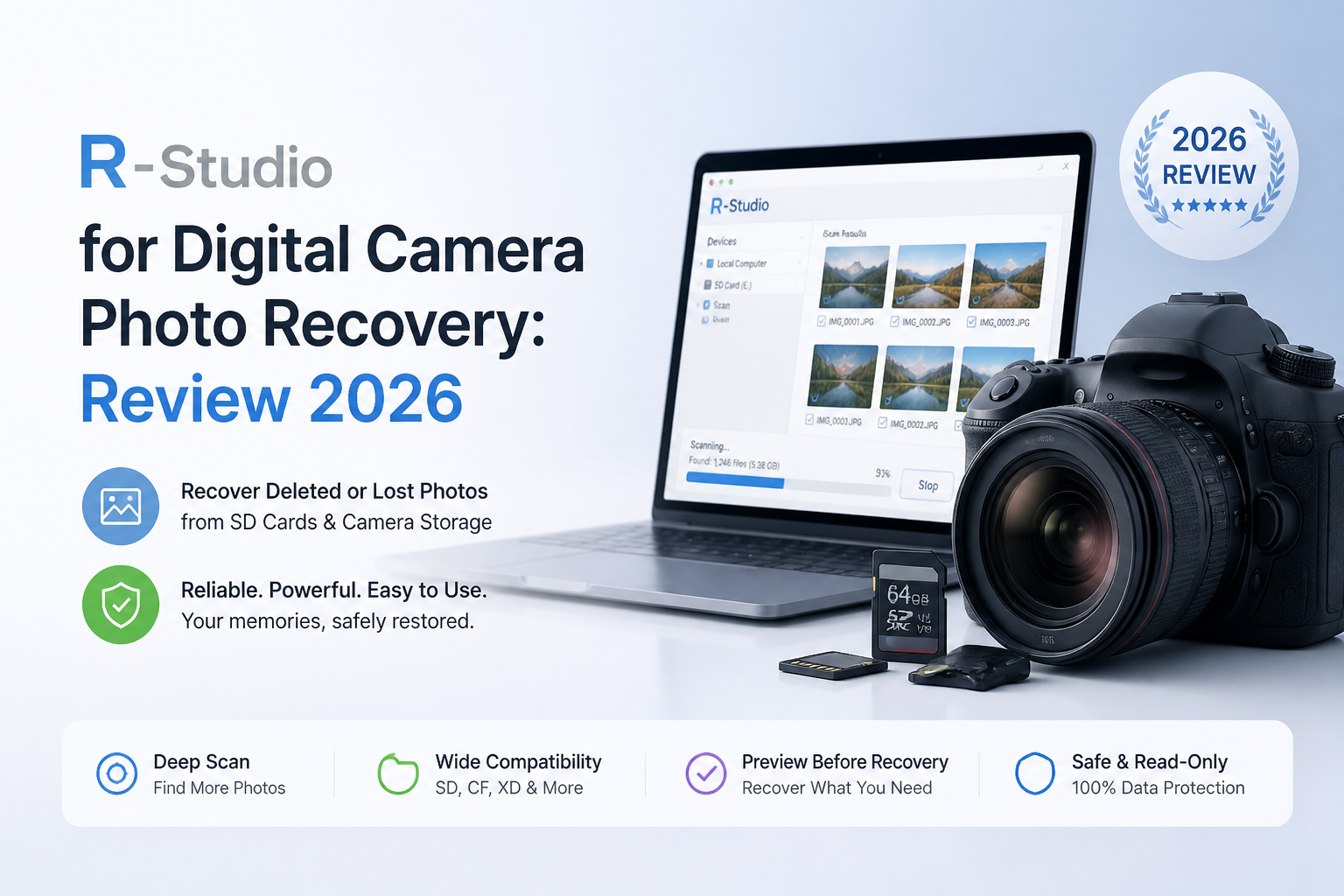
R-Studio for Camera Cards at a Glance
5.6/10R-Studio is a professional-style data recovery application for Windows, macOS, plus Linux. It can scan damaged or formatted camera cards, locate known photo types, preview files, plus create disk images.
Best forTechnicians or experienced users who need granular control over a camera card image
- File-system plus raw signature scanning
- SD, microSD, plus CompactFlash support
- Built-in photo previewer
- Byte-for-byte card imaging
- Custom known-file definitions
- Strong file-system support
- Useful card imaging
- Detailed scan configuration
- Steep learning curve
- Tiny demo recovery limit
- Separate license for each OS edition
How R-Studio Scored for Digital Camera Photo Recovery
| Category | Performance | Score |
|---|---|---|
| 01 Camera Photo Recovery | 6.8/10 | |
| 02 Ease of Use | 3.8/10 | |
| 03 Preview and Sorting | 6.1/10 | |
| 04 Card Safety Tools | 7.4/10 | |
| 05 Cost and Licensing | 4.7/10 |
How We Evaluated R-Studio for Camera Card Recovery
We evaluated R-Studio around a photographer's normal recovery path rather than its RAID, network, or forensic features. The review covered card selection, scan configuration, known-file searches, photo previews, result filtering, card-image creation, recovery destinations, demo restrictions, plus licensing.
We also compared the documented recovery paths for a common exFAT card, a formatted card with lost file-system records, plus fragmented camera footage. Scores favor controls that reduce risky choices, make intact files easy to verify, plus explain what must be saved to a separate disk.
When Photographers Should Avoid R-Studio
Skip R-Studio if storage terminology such as sectors, offsets, recognized partitions, plus known-file signatures is unfamiliar. Its controls are useful, but they can distract from the two rules that matter most: do not write to the card, plus do not save recovered files back onto it.
Avoid all DIY recovery software if the card repeatedly disconnects, becomes unusually hot, has broken contacts, or is not detected by Disk Management or Disk Utility. Those symptoms point toward physical trouble, where repeated scans may reduce the odds of a professional recovery.
R-Studio Camera Recovery Performance by Category
01 Camera Photo Recovery
Broad format support without a photographer-first workflow
6.8/10
Camera Photo Recovery
Broad format support without a photographer-first workflow
R-Studio recognizes removable storage plus known photo file signatures, so it can search SD, microSD, CompactFlash, USB-connected cameras, plus card images. It handles common FAT32 or exFAT cards, while raw signature scans can locate files after the original file system has been damaged.
The trouble is the route to those results. A photographer may see the physical card, one or more partitions, recognized file systems, extra-found files, plus raw results at once. Those views can contain overlapping copies of the same photo, leaving the user to work out which result preserves names, dates, or folders.
R-Studio is strongest when file-system metadata remains readable. It is less approachable when the job becomes fragmented camera media reconstruction. Disk Drill separates its general scan from Advanced Camera Recovery, which is easier to understand for GoPro, DJI, Canon, Sony, Panasonic, Fujifilm, or Insta360 media.
- Searches SD, microSD, plus CompactFlash media
- Supports FAT32 plus exFAT camera cards
- Can search by known photo signatures
- Works with JPEG plus many camera RAW formats
- Results can appear across several confusing device views
- No simple photographer-focused recovery path
- Fragmented camera media needs more interpretation
02 Ease of Use
A workstation interface dropped into a one-card emergency
3.8/10
Ease of Use
A workstation interface dropped into a one-card emergency
R-Studio was built around the needs of technicians, system administrators, plus advanced users. That history remains visible. The opening screen resembles a disk management utility, with storage objects, partitions, offsets, file systems, scan regions, plus technical properties competing for attention.
For a photographer who only wants to recover yesterday's shoot, the interface creates avoidable questions. Should the whole physical card be scanned, or only its exFAT partition? Should known file types be enabled? Which recognized volume is the useful one? The software provides control before it provides reassurance.
Disk Drill is easier to follow. Select the card, choose a universal or camera-specific scan, inspect previews, then recover to another drive. That reduced decision load matters when the files involve a wedding, paid assignment, or trip that cannot be repeated.
- Experienced users get detailed scan control
- Device information is visible without extra utilities
- Scans can be saved for later inspection
- Dense interface is intimidating during an urgent recovery
- Several result trees may describe the same card
- Important choices use storage terminology rather than plain language
03 Preview and Sorting
Useful inspection tools with too much surrounding clutter
6.1/10
Preview and Sorting
Useful inspection tools with too much surrounding clutter
R-Studio includes a built-in viewer for photos plus other supported files. Previewing is essential because a filename alone does not prove that a recovered JPEG or RAW file is intact. Filters, timestamps, file extensions, plus recovery-chance estimates can help narrow a large card scan.
Still, browsing is slowed by technical result groups plus duplicate-looking entries. Raw-found photos may lose their original names or folder locations, which is expected when metadata is gone, but R-Studio does not make the cleanup job feel especially friendly. Sorting hundreds of generic filenames is workable, not pleasant.
Disk Drill presents photos in a more visual results browser, with familiar filters plus previews placed closer to the main recovery flow. That makes it easier to check a burst sequence or locate a specific shoot date before paying.
- Built-in previews help verify individual photos
- Filters can narrow results by type or date
- Recovery-chance estimates provide useful context
- Scan information can be saved
- Duplicate-looking result groups take time to compare
- Raw recovery may produce generic filenames
- Browsing feels closer to file forensics than photo selection
04 Card Safety Tools
Imaging controls are the strongest part of R-Studio
7.4/10
Card Safety Tools
Imaging controls are the strongest part of R-Studio
R-Studio can create a byte-for-byte image of a memory card, then scan that image instead of repeatedly reading the original media. This is the right basic approach for an unstable card because it preserves a point-in-time copy while keeping recovery writes away from the source.
The software also displays S.M.A.R.T. information for supported drives, handles bad sectors, plus lets advanced users define scan ranges. Some of that is more relevant to hard drives than camera cards, but the imaging function is genuinely valuable. A card image can also be created in demo mode.
Disk Drill includes byte-to-byte backup in a less technical interface. Neither application can make a physically failing card safe, so cards that disconnect, heat up, or vanish from the operating system should go to a recovery lab rather than endure repeated DIY scans.
- Creates full byte-for-byte card images
- Can scan an image rather than the original card
- Keeps recovered files directed to separate storage
- Offers detailed control for cards with readable bad sectors
- Imaging controls still assume some storage knowledge
- DIY software is unsafe for cards with severe physical failure
05 Cost and Licensing
A low headline price weakened by a tiny demo limit
4.7/10
Cost and Licensing
A low headline price weakened by a tiny demo limit
R-Studio's local license costs $79.99. Its demo can scan, preview supported files, create card images, plus recover individual files smaller than 1,024 KB. That file-size ceiling is barely useful for modern camera work. One RAW image or high-resolution JPEG will usually exceed it.
The license is also tied to a specific operating-system edition. A Windows key cannot activate R-Studio for macOS or Linux. Photographers who move between a Windows desktop plus a MacBook may need another license.
Disk Drill costs $89 per year or $149 for a lifetime license. It is more expensive upfront, yet one personal license covers Windows plus macOS on up to three owned computers. The Windows Basic edition recovers up to 100 MB free, while both platforms support scanning plus previews before purchase. The broader license makes more sense for a mixed-computer photo workflow.
- Local R-Studio license is a one-time $79.99 purchase
- Demo supports full scans plus file previews
- Card-image creation remains available before purchase
- Demo recovery is limited to files below 1,024 KB each
- Windows, macOS, plus Linux keys are sold separately
- Small demo allowance is unrealistic for current RAW photos
R-Studio vs Disk Drill for Camera Recovery
We compared the two applications around the jobs photographers actually face, including formatted cards, visual file checks, card imaging, plus fragmented camera footage. The focus was usability as much as raw technical reach.
| Metric | R-Studio | Disk Drill |
|---|---|---|
| Camera-focused scan mode | General file-system plus signature scans | Dedicated Advanced Camera Recovery |
| Fragmented camera video | Traditional recovery with manual AVCHD workflow | Format-aware reconstruction for supported cameras |
| Photo result browsing | Powerful, though spread across technical result trees | Visual categories, filters, search, plus previews |
| Card imaging | Detailed image creation plus scan controls | Simpler byte-to-byte backup workflow |
| Free recovery allowance | Files under 1,024 KB each | 100 MB total on Windows; preview-first on Mac |
| Personal license coverage | Separate key for each operating system | Windows plus macOS, up to three owned computers |
| Pricing | $79.99 one-time for one OS edition | $89/year or $149 lifetime with updates |
| Overall score | 5.6 / 10 | 8.8 / 10 |
What to Use Instead
Choose Disk Drill if you need to recover photos or footage without learning the layout of partitions, sectors, plus recognized file systems first.
01 Disk Drill
A calmer route through damaged camera-card recovery
8.8/10
Disk Drill
A calmer route through damaged camera-card recovery
Disk Drill is the better option for most photographers because it turns the recovery process into a short, visible sequence. Pick the card, choose Universal Scan or Advanced Camera Recovery, check the previews, then save selected files to another device.
Its Advanced Camera Recovery module is the main reason to choose it for camera work. The mode is designed to reconstruct fragmented photo, audio, plus video data from supported Canon, Sony, Nikon, Panasonic, Fujifilm, GoPro, DJI, Insta360, plus other devices. A universal scan can then be run separately to look for additional files.
The free edition is still a trial rather than a complete recovery tool. Windows users get 100 MB of free recovery, while Mac users mainly scan plus preview before upgrading. Check several full-size previews before paying, particularly with RAW files or long video clips.
- Dedicated Advanced Camera Recovery mode
- Clearer previews plus photo filters
- Byte-to-byte card backups
- One personal license covers Windows plus macOS
- Annual plus lifetime purchase choices
- Large recoveries require Disk Drill PRO
- The $149 lifetime license costs more upfront
- No software can restore overwritten card sectors

What Camera Recovery Users Report About R-Studio Plus Disk Drill
A user recovering a reformatted 14 TB drive said R-Studio restored the original names plus folder structure after Disk Drill showed a more jumbled result. It is a strong reminder that R-Studio can excel when intact file-system metadata matters.
The poster recovered family photos plus camera videos from an inaccessible RAW SD card with Disk Drill. They credited Advanced Camera Recovery for producing usable results from fragmented footage.
One Disk Drill buyer said the recovered files did not work despite promising scan results, followed by a poor support experience. Previewing representative full-size files before paying remains essential.
A user reported that R-Studio recovered an APFS drive with its tree structure plus metadata after Disk Drill returned only part of the data in bulk. That experience concerns a hard drive rather than a camera card.
Should Photographers Use R-Studio in 2026?
R-Studio is capable recovery software, but we do not recommend it as the first choice for digital camera photo recovery. Its device-tree interface, overlapping result views, tiny 1,024 KB demo allowance, plus single-OS licensing create friction around a job that is already stressful.
Experienced recovery technicians may prefer its granular imaging plus file-system controls. Most photographers should download Disk Drill, make a byte-to-byte card backup, run Advanced Camera Recovery for camera media, then confirm several previews before buying PRO.
Stop using the camera card immediately, lock its write-protect tab if available, create a byte-to-byte image, then recover files to a different drive.